DISCLAIMER

“GED®
is a registered trademark of the American Council on Education (ACE) and
administered exclusively by GED Testing Service LLC under license. This material [or
content] is not endorsed or approved by ACE or GED Testing Service.”

Thursday, January 28, 2016

GED Lesson: Ratio and Proportions (Cross Multiplying)


Click here for practice problems


Cross-multiplication

From Wikipedia, the free encyclopedia
  (Redirected from Cross multiplying)
In mathematics, specifically in elementary arithmetic and elementary algebra, given an equation between two fractions or rational expressions, one can cross-multiply to simplify the equation or determine the value of a variable.
Given an equation like:
\frac a b = \frac c d
(where b and d are not zero), one can cross-multiply to get:
ad = bc \qquad \mathrm{or} \qquad a = \frac {bc} d.
In Euclidean geometry the same calculation can be achieved by considering the ratios as those of similar triangles.

Procedure[edit]

In practice, the method of cross-multiplying means that we multiply the numerator of each (or one) side by the denominator of the other side, effectively crossing the terms over.
\frac a b \nwarrow \frac c d \quad \frac a b \nearrow \frac c d.
The mathematical justification for the method is from the following longer mathematical procedure. If we start with the basic equation:
\frac a b = \frac c d
we can multiply the terms on each side by the same number and the terms will remain equal. Therefore, if we multiply the fraction on each side by the product of the denominators of both sides—bd—we get:
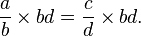
\frac a b \times bd = \frac c d \times bd.
We can reduce the fractions to lowest terms by noting that the two occurrences of b on the left-hand side cancel, as do the two occurrences of d on the right-hand side, leaving:
ad = bc
and we can divide both sides of the equation by any of the elements—in this case we will use d—getting:
a = \frac {bc} d.
Another justification of cross-multiplication is as follows. Starting with the given equation:
\frac a b = \frac c d
multiply by d/d = 1 on the left and by b/b = 1 on the right, getting:
\frac a b \times \frac d d = \frac c d \times \frac b b
and so:
\frac {ad} {bd} = \frac {cb} {db}.
Cancel the common denominator bd = db, leaving:
ad = cb.
Each step in these procedures is based on a single, fundamental property of equations. Cross-multiplication is a shortcut, an easily understandable procedure that can be taught to students.

Use[edit]

This is a common procedure in mathematics, used to reduce fractions or calculate a value for a given variable in a fraction. If we have an equation like this, where x is a variable we are interested in solving for:
\frac x b = \frac c d
we can use cross multiplication to determine that:
x = \frac {bc} d.
SAMPLE PROBLEM
For example, let's say that we want to know how far a car will get in 7 hours, if we happen to know that its speed is constant and that it already travelled 90 miles in the last 3 hours. Converting the word problem into ratios we get
\frac x {7\ \mathrm{hours}} = \frac {90\ \mathrm{miles}} {3\ \mathrm{hours}}.
Cross-multiplying yields:
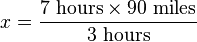
x = \frac {7\ \mathrm{hours} \times 90\ \mathrm{miles}} {3\ \mathrm{hours}}
and so:
x = 210\ \mathrm{miles}.
Note that even simple equations like this:
a = \frac {x} {d}
are solved using cross multiplication, since the missing b term is implicitly equal to 1:
\frac a 1 = \frac x d.
Any equation containing fractions or rational expressions can be simplified by multiplying both sides by the least common denominator. This step is called clearing fractions.

Rule of Three[edit]

The Rule of Three[1] is a shorthand version for a particular form of cross-multiplication, that may be taught to students by rote. It figures in the French national curriculum for secondary education.[2]
For an equation of the form:
\frac a b = \frac c x
where the variable to be evaluated is in the right-hand denominator, the Rule of Three states that:
x = \frac {bc} a.

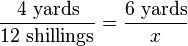
\frac {4\ \mathrm{yards}} {12\ \mathrm{shillings}} = \frac {6\ \mathrm{yards}} { x}
and then using cross-multiplication to calculate x:
x = \frac {12\ \mathrm{shillings} \times 6\ \mathrm{yards}} {4\ \mathrm{yards}} = 18\ \mathrm{shillings}.

Click here for practice problems

    GED LESSON: Mindset and Math


    FULL EDWEEK ARTICLE


    "Having a positive mindset in math may do more than just help students feel more confident about their skills and more willing to keep trying when they fail; it may prime their brains to think better.
    In an ongoing series of experiments at Stanford University, neuroscientists have found more efficient brain activity during math thinking in students with a positive mindset about math.
    It's part of a growing effort to map the biological underpinnings of what educators call a positive or growth mindset, in which a student believes intelligence or other skills can be improved with training and practice, rather than being fixed and inherent traits.
    "Our findings provide strong evidence that a positive mindset contributes to children's math competence," said Lang Chen, a Stanford University postdoctoral fellow in cognitive psychology and neuroscience. "Beyond the emotional or even motivational story of 'positive mindset,' there may be cognitive functions supporting the story."


    Monday, November 16, 2015

    GED LESSON: Introduction to Ratios


    KHAN ACADEMY INTRODUCTION TO RATIOS VIDEO 


    In mathematics, a ratio is a relationship between two numbers indicating how many times the first number contains the second.[1] For example, if a bowl of fruit contains eight oranges and six lemons, then the ratio of oranges to lemons is eight to six (that is, 8:6, which is equivalent to the ratio 4:3). Thus, a ratio can be a fraction as opposed to a whole number. Also, in this example the ratio of lemons to oranges is 6:8 (or 3:4), and the ratio of oranges to the total amount of fruit is 8:14 (or 4:7).
    The numbers compared in a ratio can be any quantities of a comparable kind, such as objects, persons, lengths, or spoonfuls. A ratio is written "a to b" or a:b, or sometimes expressed arithmetically as a quotient of the two.[2]When the two quantities have the same units, as is often the case, their ratio is a dimensionless number. A rate is a quotient of variables having different units. But in many applications, the word ratio is often used instead for this more general notion as well.[3]

    The ratio of numbers A and B can be expressed as:[4]
    • the ratio of A to B
    • A is to B (followed by "as C is to D")
    • A:B
    • A fraction that is the quotient: A divided by B: \tfrac{A}{B}, which can be expressed as either a simple or a decimal fraction.[5]
    The numbers A and B are sometimes called terms with A being the antecedent and B being the consequent.[6]
    The proportion expressing the equality of the ratios A:B and C:D is written A:B = C:D or A:B::C:D. This latter form, when spoken or written in the English language, is often expressed as
    A is to B as C is to D.
    A, B, C and D are called the terms of the proportion. A and D are called the extremes, and B and C are called the means. The equality of three or more proportions is called a continued proportion.[7]
    Ratios are sometimes used with three or more terms. The ratio of the dimensions of a "two by four" that is ten inches long is 2:4:10. A good concrete mix is sometimes quoted as 1:2:4 for the ratio of cement to sand to gravel.[8]
    For a mixture of 4/1 cement to water, it could be said that the ratio of cement to water is 4:1, that there is 4 times as much cement as water, or that there is a quarter (1/4) as much water as cement.

    Monday, October 26, 2015

    GED LESSON: Success GED Absolute Value Lesson

    Khan Academy Full Course on Absolute Value


    Read full Eduplace article here

    Absolute Value

    Absolute value describes the distance of a number on the number line from 0 without considering which direction from zero the number lies. The absolute value of a number is never negative.
    • The absolute value of 5 is 5.
    • distance from 0: 5 units


    • The absolute value of negative5 is 5.
    • distance from 0: 5 units


    • The absolute value of 2 + negative7 is 5.
    • distance of sum from 0: 5 units

    • The absolute value of 0 is 0. (This is why wedon't say that the absolute value of a number is positive: Zero is neither negative nor positive.)
    The symbol for absolute value is two straight lines surrounding the number or expression for which you wish to indicate absolute value.

    • |6| = 6 means the absolute value of 6 is 6.
    • |negative6| = 6 means the absolute value of negative6 is 6.
    • |negative2 - x| means the absolute value of negative2 minus x.
    • negative|x| means the negative of the absolute value of x.

    Monday, September 28, 2015

    GED LESSON: Robert Kiyosaki How to Make Money or Get Rich


    Robert Kiyosaki From YouTube 

    Watch this video about making money and getting rich. You should do your own thinking about this subject. One of the main reasons people have for taking the GED is to make more money. Start thinking about that now, even before you take the test. Press the subject buttons on the right or look at the posts other posts in the blog to work on specific GED subjects.

    Full Wikipedia Article
    Robert Toru Kiyosaki (born April 8, 1947) is an American businessman, investor, self-help author, motivational speaker, financial literacy activist, financial commentator, and radio personality. Kiyosaki is the founder of the Rich Dad Company.[3] He has written over 15 books which have combined sales of over 26 million copies.[4]
    A financial literacy advocate, Kiyosaki has been a proponent of entrepreneurship, business education, investing, and that comprehensivefinancial literacy concepts should be taught in schools around the world.[5] Kiyosaki also maintains a monthly column on Yahoo Finance.[6][7]

    Full Article


    Thursday, September 10, 2015

    GED LESSON: What the hell are negative numbers, and why do I need to learn about them

    Video below from Khan Academy


    Full article from Wikipedia here


    In mathematics, a negative number is a real number that is less than zero. Negative numbers represent opposites. If positive represents movement to the right, negative represents movement to the left. If positive represents above sea level, then negative represents below level. If positive represents a deposit, negative represents a withdrawal. They are often used to represent the magnitude of a loss or deficiency. A debt that is owed may be thought of as a negative asset, a decrease in some quantity may be thought of as a negative increase. If a quantity may have either of two opposite senses, then one may choose to distinguish between those senses—perhaps arbitrarily—as positive and negative. In the medical context of fighting a tumor, an expansion could be thought of as a negative shrinkage. Negative numbers are used to describe values on a scale that goes below zero, such as the Celsius and Fahrenheit scales for temperature. The laws of arithmetic for negative numbers ensure that the common sense idea of an opposite is reflected in arithmetic. For example, − − 3 = 3 because the opposite of an opposite is the thing you started with.
    Negative numbers are usually written with a minus sign in front. For example, −3 represents a negative quantity with a magnitude of three, and is pronounced "minus three" or "negative three". To help tell the difference between a subtraction operation and a negative number, occasionally the negative sign is placed slightly higher than the minus sign (as a superscript). Conversely, a number that is greater than zero is called positive; zero is usually[1] thought of as neither positive nor negative.[2] The positivity of a number may be emphasized by placing a plus sign before it, e.g. +3. In general, the negativity or positivity of a number is referred to as its sign.

    Tuesday, August 11, 2015

    GED LESSON: Multiplying with Negative numbers


    Success GED Multiplying with Negative numbers 


    Watch the Khan Academy Video below 


    The Multiplication Rules: 

    Positive times a positive = Positive
    Negative times a negative = Positive 
    Positive times a negative = Negative
    Negative times a Positive = Negative

    Theory        ,    Examples 

    + x + = +,   +5 x +2 = +10
    - x - = +,      -5 x -2 = +10
    + x - = -,      +5 x -2 = -10
    - x + = -,      -5 x +2 = -10

    Why is negative times a negative a positive?

    -1 x +2 = -2 (Negative means, "No, you have to change!" The negative sign is very negative!) 

    -1 x -2 = +2 (Because the negative sign of the -1 forcing the -2 to change signs. Bossy!)

    Lets get deeper... 

    -1 x -2 x -3 = ??

    Okay, first things first: Take -1 x -2 first. We know that negative is going to make the -2 positive, so -1 x -2 = +2.
    Take the +2 x -3. The rule  is positive is cool if you keep your sign. So +2 x -3 = -6. So -1 x -2 x -3 = -6. 

    So the more useful rule is that if there are an odd number of negative numbers you're multiplying, the answer will be negative. If there are an even number, the answer will be positive.